

Next-Generation Horticulture Quantum Sensors Market Trends 2026-2036: Innovation Catalysts, Regulatory Impact
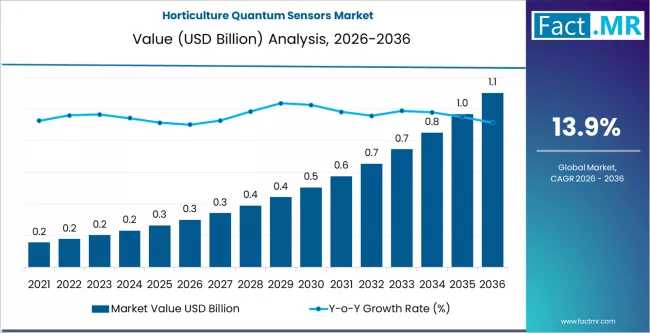
Horticulture Quantum Sensors Market Size
Global Horticulture Quantum Sensors Market Projected to Reach $1.1 Billion by 2036 as Precision Agriculture Adoption Accelerates
UNITED STATES, MD, UNITED STATES, January 19, 2026 /EINPresswire.com/ -- The global horticulture quantum sensors market is entering a phase of rapid commercial expansion, with new data projecting the sector will grow from $0.3 billion in 2026 to $1.1 billion by 2036. According to recent industry analysis, this trajectory represents a 13.9% compound annual growth rate (CAGR), driven by the urgent integration of quantum-scale precision into indoor farming, greenhouse management, and plant research.As traditional agricultural methods face increasing pressure from climate volatility and resource scarcity, quantum sensors have emerged as a critical tool for Photosynthetic Photon Flux Density (PPFD) measurement. Unlike classical sensors, these quantum-enabled devices leverage single-photon detection and atomic-scale sensitivity to provide growers with an unprecedented granular view of light interception and plant health.
Request for Sample Report | Customize Report |purchase Full Report - https://www.factmr.com/connectus/sample?flag=S&rep_id=13669
Market Dynamics: The Shift to Quantum-Enabled Cultivation
The surge in market valuation is primarily attributed to the Precision Agriculture Revolution. Industrial growers are transitioning away from broad environmental monitoring toward real-time, data-centric management.
Greenhouse Dominance: Greenhouse applications are expected to command 41.8% of the market share in 2026. These controlled environments require hyper-accurate light data to balance supplemental LED lighting with natural solar radiation, directly impacting crop yield and energy overhead.
PAR Sensor Leadership: Quantum Photosynthetically Active Radiation (PAR) sensors are projected to maintain a 61.6% market share. These devices measure the specific light frequencies plants use for photosynthesis ($400$ to $700$ nm), allowing for the optimization of light recipes in vertical farms.
Vertical Farming & Research: The rise of urban vertical farming and academic plant research continues to fuel demand for wireless light sensor nodes and handheld meters that can detect subtle biochemical changes in crops before physical symptoms of stress appear.
Technological Innovation and Industry Impact
The transition from laboratory research to commercial reality is being accelerated by breakthroughs in miniaturization and IoT integration. Modern quantum sensors are no longer restricted to high-cost research facilities; they are being integrated directly into climate control systems and automated irrigation manifolds.
Quantum sensors represent a paradigm shift in how we understand plant-environment interactions, says a senior market analyst. By detecting minute variations in light intensity and spectral quality at the quantum level, growers can achieve up to a 20% increase in yield while reducing resource inputs like water and electricity by as much as 35%.
Regional Outlook and Key Players
North America currently leads the global market, supported by a mature AgTech ecosystem and significant federal investment in quantum information sciences. However, the Asia-Pacific region is identified as the fastest-growing market, propelled by large-scale smart farming initiatives in China, India, and Singapore.
Prominent organizations shaping the competitive landscape include:
Apogee Instruments, Inc. (USA)
LI-COR Biosciences (USA)
METER Group (USA/Germany)
Skye Instruments Ltd (UK)
Delta-T Devices (UK)
Strategic Challenges
While the growth outlook remains robust, the industry faces hurdles related to high initial deployment costs and the need for standardized data protocols. The market is responding through the development of OEM Integration models, where quantum sensing modules are embedded directly into third-party greenhouse automation hardware, lowering the barrier to entry for mid-sized commercial operations.
About the Horticulture Quantum Sensors Market Report This press release is based on comprehensive market intelligence covering historical trends from 2021–2025 and 10-year forecasts through 2036. The analysis segments the market by sensor type (PAR, Spectral, Wireless), end-use (Greenhouses, Vertical Farms, Research), and installation mode.
To View Related Report :
Yaw Rate Sensors Market
https://www.factmr.com/report/557/yaw-rate-sensors-market
Chemical Sensors Market
https://www.factmr.com/report/1749/chemical-sensors-market
Gas Sensors Market
https://www.factmr.com/report/1966/gas-sensors-market
Tilt Sensors Market
https://www.factmr.com/report/2101/tilt-sensors-market
About Fact.MR
Fact.MR is a global market research and consulting firm, trusted by Fortune 500 companies and emerging businesses for reliable insights and strategic intelligence. With a presence across the U.S., UK, India, and Dubai, we deliver data-driven research and tailored consulting solutions across 30+ industries and 1,000+ markets. Backed by deep expertise and advanced analytics, Fact.MR helps organizations uncover opportunities, reduce risks, and make informed decisions for sustainable growth.
Shahir
Fact.MR
+1 35314434232
email us here
Legal Disclaimer:
EIN Presswire provides this news content "as is" without warranty of any kind. We do not accept any responsibility or liability for the accuracy, content, images, videos, licenses, completeness, legality, or reliability of the information contained in this article. If you have any complaints or copyright issues related to this article, kindly contact the author above.
