

Bamboo Fiber Reinforced Panels Market Price Outlook and Future Industry Trends (2026–2036)
Rising demand for sustainable, high-performance construction materials accelerates adoption across furniture and modular building industries
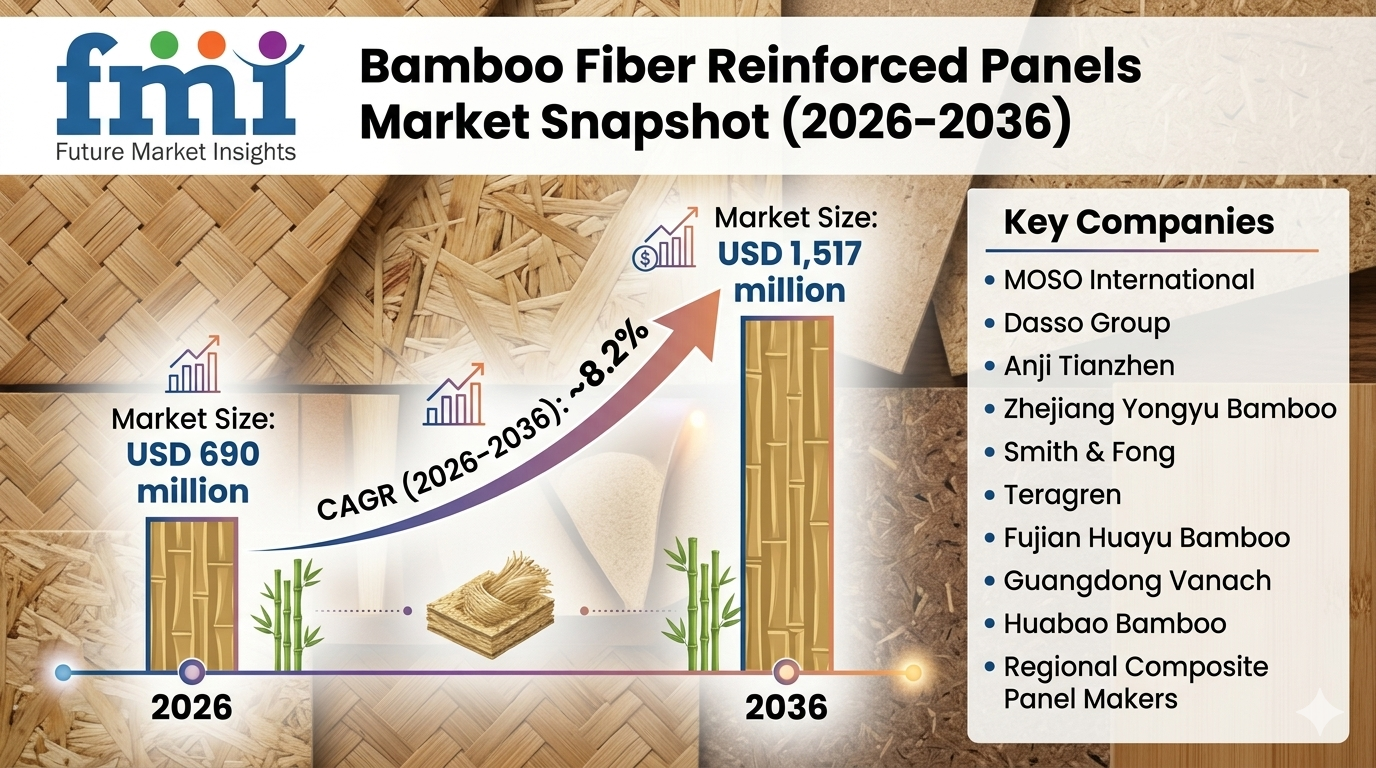
NEWARK, DE, UNITED STATES, March 23, 2026 /EINPresswire.com/ -- The global Bamboo Fiber Reinforced Panels Market is estimated to reach USD 690 million in 2026 and is projected to expand to USD 1,517 million by 2036, registering a CAGR of 8.2% during the forecast period. Growth is being driven by increasing specification of engineered bamboo panels in interior construction systems where dimensional stability, uniform mechanical performance, and sustainability credentials are critical.
As construction and furniture manufacturing industries transition toward renewable and low-carbon materials, bamboo fiber reinforced panels are emerging as a viable alternative to traditional wood-based boards. These panels are evolving from niche architectural materials into standardized engineered solutions integrated into modular construction and industrial furniture production workflows.
Bamboo Fiber Reinforced Panels Market Snapshot (2026–2036)
• Market size in 2026: USD 690 million
• Market size in 2036: USD 1,517 million
• CAGR (2026–2036): ~8.2%
• Leading panel type: Bamboo fiber composite boards
• Top application: Interior wall & ceiling panels
• Dominant end-use segment: Residential construction
• Leading region: Asia-Pacific
Market Momentum
The market begins at USD 690 million in 2026, supported by growing adoption of engineered bamboo panels in furniture manufacturing and interior construction. Between 2028 and 2032, expansion of modular housing and prefabricated building systems is expected to accelerate demand.
By 2036, the market reaches USD 1.5 billion, reflecting steady integration of bamboo composites into mainstream construction and furniture supply chains. Growth remains driven by specification-based procurement, where performance consistency and sustainability compliance are prioritized over cost alone.
Request For Sample Report | Customize Report |purchase Full Report - https://www.futuremarketinsights.com/reports/sample/rep-gb-32368
Why the Market is Growing
The Bamboo Fiber Reinforced Panels Market is expanding as industries seek alternatives to conventional timber and synthetic panels. Furniture manufacturers are increasingly adopting bamboo composites due to their consistent machining behavior, dimensional stability, and reliable fastening performance.
In construction, bamboo panels align with modular building systems by offering lightweight, standardized, and easy-to-install materials. Additionally, green building certifications and sustainability mandates are encouraging the use of rapidly renewable materials such as bamboo.
Unlike traditional materials, engineered bamboo panels provide repeatable performance across batches, making them suitable for industrial-scale production and large construction projects.
Segment Spotlight
1. Panel Type: Bamboo Fiber Composite Boards Lead Demand
Bamboo fiber composite boards account for approximately 44% of the market share. Their dominance is attributed to superior machinability, uniform fiber distribution, and compatibility with existing panel processing technologies used in furniture and construction industries.
2. Application: Interior Wall & Ceiling Panels Dominate
Interior wall and ceiling panels represent around 30% of total demand. These applications benefit from bamboo panels’ lightweight structure, moisture stability, and aesthetic finish, making them ideal for residential and commercial interiors.
3. End Use: Residential Segment Leads Growth
The residential sector holds nearly 38% share, driven by increasing adoption of sustainable interior materials in housing projects, including modular homes and prefabricated structures.
Drivers, Opportunities, Trends, Challenges
• Drivers: Growth in modular construction, rising demand for sustainable materials, constraints in hardwood supply
• Opportunities: Expansion of bamboo processing infrastructure, hybrid composite innovations, export-oriented panel manufacturing
• Trends: Specification-driven procurement, increasing certification requirements, integration into industrial furniture production
• Challenges: Limited processing infrastructure outside Asia, lack of standardized building codes for bamboo composites
Regional Growth Outlook (2026–2036)
Asia-Pacific dominates the global market with approximately 66% share, supported by abundant bamboo resources and established manufacturing ecosystems. Countries such as India, China, and Vietnam are leading growth due to strong construction demand and integrated bamboo supply chains.
India is projected to grow at a CAGR of 9.5%, driven by government-backed bamboo initiatives and increasing adoption in modular housing. China follows with 8.6% CAGR, supported by large-scale production and exports. Southeast Asian countries including Vietnam, Indonesia, and the Philippines continue to expand due to resource availability and rising investment in engineered bamboo products.
Developed markets such as the United States and Germany show slower but steady growth, driven by green building certifications and demand for sustainable architectural materials.
Competitive Landscape
The market is moderately fragmented, with regional manufacturers and engineered panel producers competing on product quality, material consistency, and sustainability credentials. A significant portion of production capacity is concentrated in Asia, where vertically integrated players control bamboo sourcing, fiber processing, and panel manufacturing.
Competition increasingly focuses on fiber treatment technologies, resin bonding efficiency, and compliance with global building standards. Companies are also investing in certification, product traceability, and partnerships with construction firms and furniture manufacturers to strengthen market positioning.
Frequently Asked Questions (FAQ)
What is the global Bamboo Fiber Reinforced Panels Market size?
The market is valued at USD 690 million in 2026 and is projected to reach USD 1,517 million by 2036.
What is the expected growth rate?
The market is expected to grow at a CAGR of approximately 8.2% during 2026–2036.
What are bamboo fiber reinforced panels?
They are engineered panels made by combining bamboo fibers with resins or binders to enhance strength, durability, and dimensional stability for construction and furniture applications.
Why are bamboo panels gaining importance?
They offer a sustainable, renewable alternative to wood-based panels while delivering consistent performance, making them suitable for modern construction and manufacturing systems.
Explore More Related Studies Published by FMI Research:
Fluorine-Free Oil & Grease Repellent Polymers Market https://www.futuremarketinsights.com/reports/fluorine-free-oil-and-grease-repellent-polymers-market
Fluorine-Free Barrier Coatings Market https://www.futuremarketinsights.com/reports/fluorine-free-barrier-coatings-market
Specialty Amine Curing Agents Market https://www.futuremarketinsights.com/reports/specialty-amine-curing-agents-market
About Future Market Insights (FMI)
Fture Market Insights, Inc. (FMI) is an ESOMAR-certified, ISO 9001:2015 market research and consulting organization, trusted by Fortune 500 clients and global enterprises. With operations in the U.S., UK, India, and Dubai, FMI provides data-backed insights and strategic intelligence across 30+ industries and 1200 markets worldwide.
Why Choose FMI: https://www.futuremarketinsights.com/why-fmi
Sudip Saha
Future Market Insights Inc.
+1 347-918-3531
rahul.singh@futuremarketinsights.com
Legal Disclaimer:
EIN Presswire provides this news content "as is" without warranty of any kind. We do not accept any responsibility or liability for the accuracy, content, images, videos, licenses, completeness, legality, or reliability of the information contained in this article. If you have any complaints or copyright issues related to this article, kindly contact the author above.
