

Plastic Jar Packaging Market 2026–2036 | USD 7.5 Billion Forecast, India & China Lead, Silgan & Berry Global Lead
Plastic Jar Packaging Market
US plastic jar sales to grow at 4.7% CAGR to 2036, driven by nutraceutical demand, PCR adoption, PET shift, and supply chain resilience.
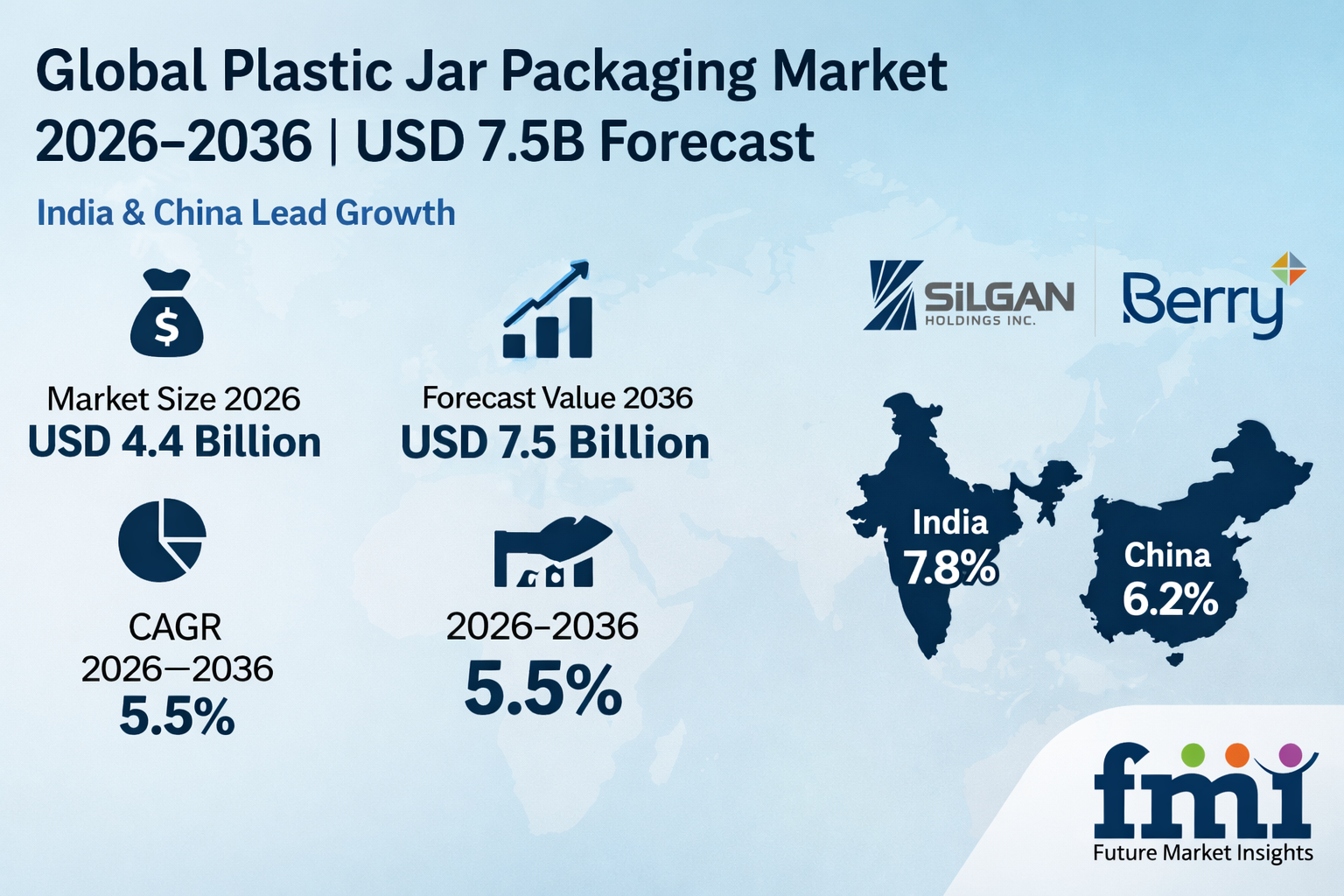
NEWARK , DE, UNITED STATES, March 27, 2026 /EINPresswire.com/ -- The global plastic jar packaging market is entering a decisive decade of transformation, where sustainability, premium aesthetics, and cost efficiency converge to redefine rigid packaging strategies. According to the latest analysis by Future Market Insights (FMI), the market is projected to reach USD 4.4 billion in 2026 and expand at a 5.5% CAGR, surpassing USD 7.5 billion by 2036.
What makes this growth compelling for decision-makers is not just the numbers but the structural shift from glass to advanced polymer formats, driven by recyclability mandates, logistics optimization, and evolving consumer expectations in cosmetics, food, and healthcare packaging.
Quick Stats Snapshot
• Market Size (2026): USD 4.4 Billion
• Forecast Value (2036): USD 7.5 Billion
• CAGR (2026–2036): 5.5%
• Top Jar Type: Wide-mouth jars (52.3% share)
• Leading Application: Cosmetics packaging (38.5%)
• Core Manufacturing Process: Injection molding (42%)
• High-Growth Regions: India (7.8%), China (6.2%), USA (4.7%)
Get Access of Research Report Sample: https://www.futuremarketinsights.com/reports/sample/rep-gb-3076
A Market Redefined by Material Intelligence, Not Just Volume
The plastic jar packaging industry is no longer competing on price alone it is competing on material science innovation and circularity performance. Manufacturers are actively transitioning toward mono-material PET and PP designs, eliminating mixed-material closures that currently disrupt over 40% of recycling streams.
A notable breakthrough is the rise of heavy-wall PET jars, engineered to replicate the premium tactile feel of glass while delivering up to 90% weight reduction. This single innovation is reshaping supply chains cutting freight costs, improving e-commerce viability, and significantly lowering transportation emissions.
At the same time, regulatory pressures in Europe and North America are accelerating the adoption of 30–50% Post-Consumer Recycled (PCR) content, pushing converters to develop high-clarity PCR resins that maintain shelf appeal for premium creams and gels.
Where Profitability Meets Sustainability
Behind the sustainability narrative lies a critical business reality margin discipline. EBITDA margins in this sector typically range between 15% and 22%, making operational efficiency essential for reinvestment into next-generation technologies like electric injection molding and advanced automation.
Forward-looking manufacturers are improving units produced per employee by 20–30% through robotics and inline quality inspection ensuring competitiveness even against low-cost global suppliers.
However, FMI analysis highlights a strategic risk: revenue concentration. Suppliers overly dependent on a single FMCG client (20%+ revenue share) face volatility as brands experiment with alternative formats like flexible packaging. Diversification across food, cosmetics, and industrial applications is becoming a key resilience strategy.
Why Wide-Mouth Jars and Cosmetics Lead the Revenue Engine
Wide-mouth jars dominate with 52.3% market share, not by coincidence but by usability. From skincare creams to nut butters, ease of access and product visibility directly influence consumer satisfaction and repeat purchase behavior.
Meanwhile, cosmetics packaging commands 38.5% share, driven by premiumization trends. Heavy-wall plastic jars are now the preferred packaging for high-value skincare products, offering both luxury aesthetics and sustainability compliance an increasingly non-negotiable requirement for global beauty brands.
Technology Shifts That Will Decide Market Leaders
1. PCR Integration vs. Production Efficiency
Incorporating up to 50% PCR content can increase injection molding cycle times by 10–15%, requiring advanced process control systems to maintain output without compromising quality.
2. Barrier Innovation for High-Value Formulations
Technologies like EVOH co-injection and plasma coatings are enabling plastic jars to match glass in protecting oxygen-sensitive ingredients such as Vitamin C and Retinol unlocking new high-margin applications.
3. Tooling Complexity for Safety Compliance
The shift to child-resistant (CR) closures can increase tooling costs by 30–40%, making ROI dependent on long-term contracts in pharmaceutical and regulated sectors.
The Rise of Refillable & Circular Packaging Models
A defining trend shaping the next decade is the transition toward refillable packaging systems. Brands are designing durable outer jars paired with replaceable inner pods aligning with “circular beauty” principles while enhancing customer retention.
This shift is not incremental it demands entirely new mold architectures, locking mechanisms, and supply chains. Companies that fail to adapt risk losing relevance among sustainability-driven brands and consumers.
Regional Momentum: Why India and Asia-Pacific Lead
Asia-Pacific is emerging as the growth engine of the industry, with India leading at 7.8% CAGR. Rapid urbanization, expansion of organized retail, and government-backed recycling initiatives are accelerating demand for lightweight, durable plastic jars.
China follows closely, driven by its massive cosmetics manufacturing ecosystem, while the United States focuses on PCR adoption and premium packaging innovation. Europe, particularly Germany, continues to lead in regulatory-driven circular design adoption.
Competitive Landscape: Vertical Integration Becomes the Playbook
The competitive strategy is shifting from scale to control across the value chain.
Leading players such as:
• Silgan Holdings Inc.
• Berry Global Group
• RPC Group (Indorama Ventures)
• Alpha Packaging
• Plastipak Holdings Inc.
• Graham Packaging Company
• Gerresheimer AG
• O-I Glass Inc.
are investing in PCR reprocessing, mold-making capabilities, and proprietary closure systems. This vertical integration reduces dependency, accelerates innovation cycles, and strengthens long-term contracts with global brands.
Silgan Holdings alone commands an estimated 18% market share, leveraging its extensive packaging portfolio and innovation capabilities.
Strategic Outlook: What Should Decision-Makers Watch?
• Circular compliance will become a market entry barrier, not a differentiator
• Refillable systems will redefine product design economics
• Barrier technology will unlock high-margin skincare and food applications
• Automation and productivity metrics will determine cost leadership
• Asia-Pacific will remain the primary growth battlefield
The plastic jar packaging market is not simply growing it is evolving into a high-performance, sustainability-driven ecosystem. For stakeholders across packaging, FMCG, and personal care industries, the opportunity lies in aligning design innovation with regulatory foresight and operational efficiency.
Those who invest early in circular materials, refillable systems, and advanced manufacturing will not just capture market share they will define the next standard of packaging excellence.
Frequently Asked Questions
1. How large is the global plastic jar packaging market in 2026?
The global plastic jar packaging market is estimated to reach USD 4.4 billion by 2026, driven by strong demand from cosmetics, food, and pharmaceutical industries.
2. What is the projected market size by 2036?
The market is forecast to exceed USD 7.5 billion by 2036, supported by rising adoption of lightweight, recyclable, and premium plastic packaging solutions.
3. What is the expected CAGR for the market between 2026 and 2036?
The industry is expected to grow at a compound annual growth rate (CAGR) of 5.5% during the forecast period.
4. Which jar type dominates the market?
Wide-mouth jars lead the market with a 52.3% share, primarily due to ease of use for viscous products like creams, gels, and food spreads.
5. Which end-use segment drives the highest demand?
The cosmetics packaging segment dominates with a 38.5% market share, fueled by premium skincare and beauty product demand.
Why FMI: https://www.futuremarketinsights.com/why-fmi
Explore More Research Reports by FMI:
Meat, Poultry, and Seafood Packaging Market : https://www.futuremarketinsights.com/reports/meat-poultry-and-seafood-packaging-market
Luxury Packaging Market : https://www.futuremarketinsights.com/reports/luxury-packaging-market
Masking Tape Market : https://www.futuremarketinsights.com/reports/masking-tapes-market
About Future Market Insights (FMI)
Future Market Insights (FMI) is a globally recognized market research and consulting firm, delivering data-driven insights across industries. With a strong focus on actionable intelligence, FMI supports organizations in navigating complex market transitions and identifying growth opportunities.
Sudip Saha
Future Market Insights Inc.
+1 347-918-3531
rahul.singh@futuremarketinsights.com
Legal Disclaimer:
EIN Presswire provides this news content "as is" without warranty of any kind. We do not accept any responsibility or liability for the accuracy, content, images, videos, licenses, completeness, legality, or reliability of the information contained in this article. If you have any complaints or copyright issues related to this article, kindly contact the author above.
