

Dehydrated Food Market to Reach USD 551.4 Billion by 2035, Expanding at 6.6% CAGR
Dehydrated Food Market
Market expansion is being driven by demand for shelf-stable nutrition, advanced drying technologies, post-harvest loss reduction and convenient food formats
Dehydration is evolving into a strategic food-processing solution, combining longer shelf life, supply-chain resilience and growing demand for convenient, functional nutrition.”
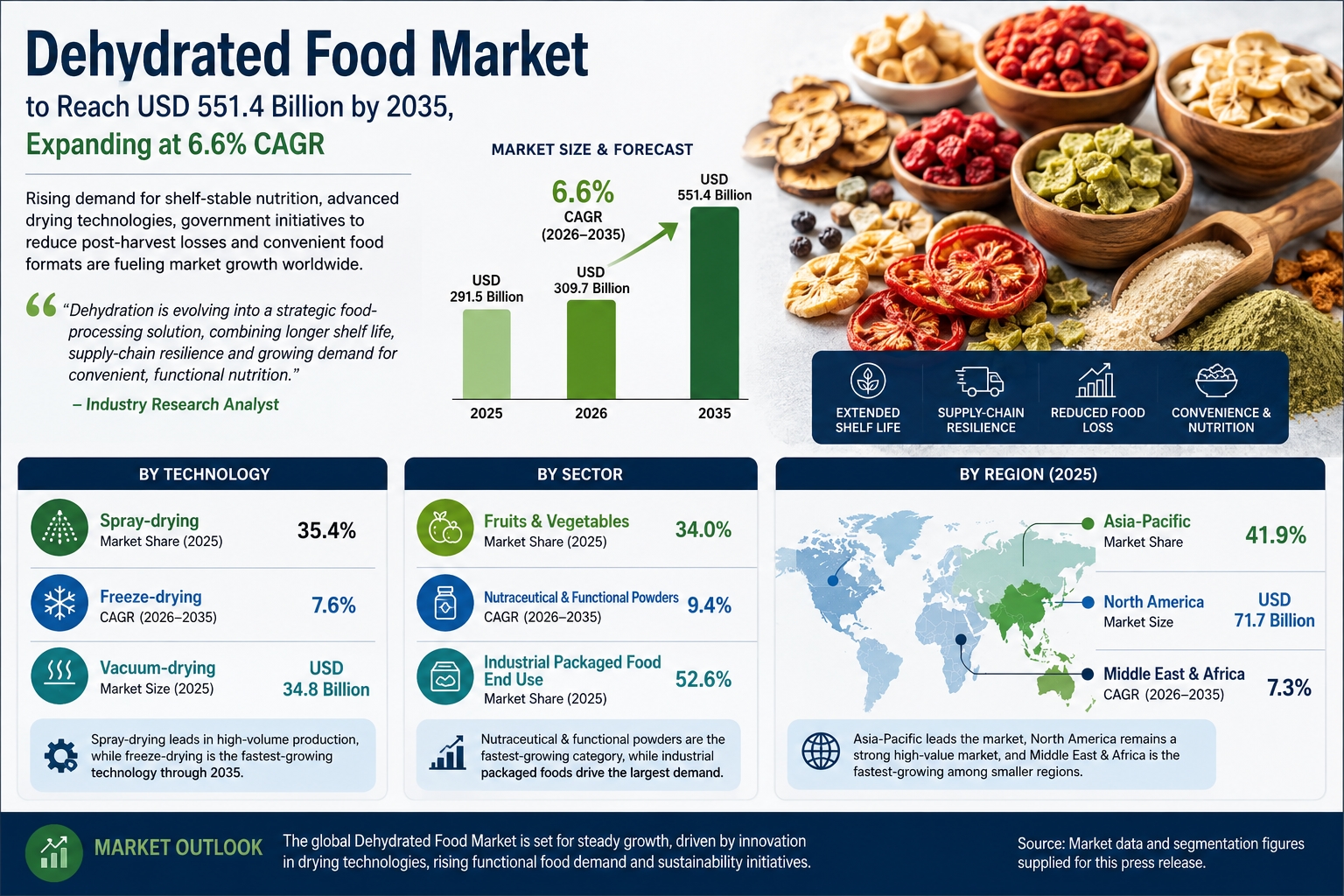
NEW YORK, NY, UNITED STATES, August 20, 2026 /EINPresswire.com/ -- The global Dehydrated Food Market is entering a sustained period of expansion as food manufacturers, retailers and consumers increasingly prioritize shelf stability, convenience, supply-chain resilience and efficient food preservation. The market was valued at USD 291.5 billion in 2025 and is projected to reach USD 309.7 billion in 2026, before expanding to USD 551.4 billion by 2035, registering a 6.6% compound annual growth rate (CAGR) during the forecast period.— Market Research Future (MRFR)
The growth trajectory reflects a fundamental transformation in the way food is processed, stored, transported and consumed. Dehydration technologies enable producers to extend shelf life, reduce product weight and volume, improve transport efficiency and create ingredients suitable for a wide range of packaged food, beverage, dairy, bakery, nutraceutical and foodservice applications.
From fruits and vegetables to dairy powders, eggs, herbs, meat products, botanical ingredients and functional nutrition powders, dehydration is increasingly positioned as a strategic processing solution rather than simply a traditional preservation technique. Improvements in spray-drying, freeze-drying, vacuum-drying and related technologies are allowing manufacturers to achieve greater consistency, improved reconstitution characteristics and enhanced preservation of selected nutritional and sensory attributes.
The market's projected growth is also closely connected to global efforts to reduce food loss and strengthen agricultural value chains. In India, the Pradhan Mantri Kisan Sampada Yojana (PMKSY) supports integrated food-processing and preservation infrastructure, value addition, post-harvest-loss reduction and cold-chain infrastructure across the food supply chain. Government programs also support expansion and modernization of food-processing and preservation capacity.
In Europe, the European Union's Farm to Fork Strategy places sustainable food systems, food-processing practices and food-loss and waste prevention at the center of the transition toward a more resilient and environmentally sustainable food chain.
Get Full PDF Sample Copy of Report: (Including Full TOC, List of Tables & Figures, Chart) @ https://www.marketresearchfuture.com/sample_request/41496
Dehydration Moves From Preservation Technique to Strategic Food-Processing Platform
Dehydrated food has historically been associated with dried fruits, vegetables, powdered milk, spices and emergency food supplies. The modern market, however, is considerably broader.
Manufacturers are increasingly using dehydration to convert agricultural commodities and perishable food products into stable ingredients that can be stored, transported and incorporated into multiple downstream formulations. This capability is particularly valuable in an environment where food companies must manage seasonal supply, fluctuating logistics costs, variable raw-material availability and consumer demand for products with longer shelf lives.
The ability to remove moisture while maintaining commercially important characteristics gives dehydration a significant role across the food value chain. Reduced water activity can inhibit microbial growth and slow chemical deterioration, while lower product weight can reduce transportation and storage requirements.
At the consumer level, demand is being reinforced by the growth of convenient food formats. Busy lifestyles, urbanization, outdoor recreation, emergency preparedness, meal kits, instant foods and ready-to-use ingredients are creating new opportunities for dehydrated products.
At the industrial level, dehydrated ingredients allow food manufacturers to simplify formulation, standardize inputs and maintain inventories for longer periods. Powders and dried concentrates can also be incorporated into beverages, bakery products, sauces, soups, snacks, nutritional products and other formulations.
The result is a market that increasingly sits at the intersection of food preservation, ingredient manufacturing, convenience and sustainability.
Market Segmentation: Technology, Sector and Geography Define Growth Opportunities
By Technology
Spray-drying commanded 35.4% of the Dehydrated Food Market in 2025, establishing itself as the leading technology by market share. Its position is supported by its scalability, high throughput and compatibility with liquid feedstocks.
Spray-drying is widely used in dairy, egg, beverage, botanical and ingredient applications where manufacturers need consistent particle characteristics and efficient conversion of liquids into stable powders. The technology's ability to integrate with continuous industrial processing makes it particularly attractive for high-volume production.
Dairy ingredients, protein powders, functional ingredients and botanical extracts are among the applications benefiting from established spray-drying infrastructure. Continued innovation in nozzle design, atomization, energy management and process control is expected to improve efficiency and product consistency.
Freeze-drying is projected to expand at a 7.6% CAGR through 2035, making it one of the fastest-growing dehydration technologies. The technology is increasingly associated with premium products where preservation of texture, appearance, aroma and selected nutritional characteristics is important.
Freeze-drying has traditionally served specialty food and pharmaceutical applications, but its presence is broadening across fruits, vegetables, coffee, functional foods, snacks and high-value ingredients. The premium positioning of freeze-dried products can support higher margins, particularly where consumers are willing to pay for convenience, long shelf life and perceived quality.
Vacuum-drying accounted for USD 34.8 billion in 2025, reflecting its importance in applications involving heat-sensitive fruits, vegetables, botanical ingredients and nutraceutical materials. By enabling moisture removal under reduced pressure, vacuum-based systems can operate at lower temperatures than some conventional drying processes.
The technology is particularly relevant for manufacturers seeking to balance moisture removal with protection of sensitive compounds and sensory characteristics. As the functional food and nutraceutical industries expand, demand for controlled drying environments is expected to create additional opportunities.
Other technologies, including drum drying, air drying and specialized hybrid drying systems, will continue serving specific product and application requirements. Technology selection will increasingly depend on raw-material characteristics, energy consumption, desired product quality, throughput and total processing economics.
By Sector
Fruits and vegetables represented 34.0% of the Dehydrated Food Market in 2025, making the category the largest product segment.
Fruits and vegetables are particularly suited to dehydration because moisture reduction can substantially extend shelf life while creating lightweight products suitable for retail and foodservice applications. Dried mango, banana, apple, berries, tomatoes, onions, potatoes, carrots and other products are used both as consumer foods and as industrial ingredients.
The sector is also benefiting from efforts to increase agricultural value addition. Instead of selling highly perishable produce immediately after harvest, processors can convert part of the crop into dried products with longer commercial windows.
This capability can help reduce dependence on immediate market access and create additional opportunities for producers and processors operating in regions with seasonal agricultural surpluses.
The nutraceutical and functional powder segment is forecast to grow at a 9.4% CAGR, the fastest rate among the categories highlighted in the market outlook.
Growth in this segment reflects increasing use of powdered botanical ingredients, fruit and vegetable concentrates, functional blends and other specialty ingredients in supplements, beverages and nutrition products. Manufacturers are increasingly seeking ingredients that can be standardized, transported efficiently and incorporated into multiple product formats.
The growing intersection between food and nutrition is likely to further expand opportunities for dehydrated functional ingredients. Powders can be used in smoothies, nutritional beverages, meal-replacement products, functional snacks and supplement formulations.
Meanwhile, industrial packaged food end use represented 52.6% of demand in 2025, underscoring the importance of commercial food manufacturers to overall market performance.
Packaged-food producers use dehydrated ingredients in soups, sauces, seasoning systems, instant meals, bakery products, snacks and ready-to-cook formulations. The ability to maintain ingredient inventories without relying exclusively on refrigerated storage can offer operational advantages, particularly in geographically distributed manufacturing networks.
By Region
Asia-Pacific led the global Dehydrated Food Market with a 41.9% share in 2025, making it the dominant regional market.
The region benefits from a combination of large agricultural production bases, expanding food-processing industries, rising urban populations and growing demand for packaged and convenient foods. India, China, Japan, South Korea and Southeast Asian economies collectively provide diverse opportunities spanning traditional dried foods, industrial ingredients, convenience products and functional nutrition.
India represents a particularly important growth market because of its agricultural scale and increasing emphasis on food processing and value addition. PMKSY's focus includes integrated processing and preservation infrastructure, cold-chain and value-addition infrastructure, and measures intended to reduce post-harvest losses.
The region's large fruit, vegetable, dairy and agricultural ingredient industries also create substantial raw-material availability for dehydration facilities.
North America generated USD 71.7 billion in 2025, supported by established packaged-food manufacturing, high consumer acceptance of convenient food formats and strong demand for functional and specialty ingredients.
The region's market is increasingly influenced by product innovation. Freeze-dried fruits, vegetable ingredients, protein powders, instant meal components and functional powders are being incorporated into products designed around convenience, nutrition and portability.
Manufacturers are also evaluating dehydration as part of broader supply-chain strategies, particularly where shelf-stable ingredients can simplify inventory management and reduce dependence on refrigerated logistics.
The Middle East & Africa is forecast to expand at a 7.3% CAGR, representing the strongest growth rate among the smaller regional markets.
The region offers significant potential because of rising urbanization, evolving food distribution networks, changing consumer lifestyles and increasing investment in food-processing capabilities. Shelf-stable foods can have particular strategic importance in markets where climatic conditions, transportation distances or infrastructure constraints create challenges for highly perishable products.
Investment in modern dehydration equipment and food-processing infrastructure could therefore contribute to greater local value addition and expanded availability of processed agricultural products.
Key Trends Shaping the Dehydrated Food Market Through 2035
Several structural trends are expected to influence the market during the forecast period.
Reducing Food Loss and Increasing Agricultural Value Addition
One of the most important drivers is the need to reduce losses between farm production and final consumption.
Dehydration can provide processors with an additional preservation pathway for agricultural products that might otherwise face spoilage because of seasonality, transportation delays or temporary oversupply.
This aligns with broader government and policy initiatives focused on sustainable food systems. The EU Farm to Fork framework specifically identifies food-loss and waste prevention as an important component of the transition to a sustainable food system.
Convenience and Shelf-Stable Nutrition
Consumers are increasingly seeking products that require minimal preparation while offering longer shelf life.
Dehydrated meals, snacks, ingredients and powders can meet these requirements by reducing preparation time and simplifying storage. The trend is particularly visible in instant meals, portable snacks, outdoor foods, emergency food products and functional beverages.
Premiumization of Freeze-Dried Products
Freeze-drying is moving beyond specialized applications into premium consumer categories.
Manufacturers are using the technology to develop products positioned around texture, flavor, appearance and ingredient quality. Freeze-dried fruit pieces, functional snacks and specialty ingredients can command premium pricing where consumers perceive a meaningful quality advantage.
Growth of Functional and Nutraceutical Powders
The rapid projected growth of nutraceutical and functional powders is creating a high-value opportunity for dehydration technology providers.
Powdered ingredients can be formulated into capsules, sachets, beverages, nutrition mixes and fortified foods. Improvements in processing and formulation technologies are also helping manufacturers develop products that are easier to standardize and distribute.
Energy Efficiency and Process Optimization
Drying can be energy-intensive, making operational efficiency an important consideration for processors.
Manufacturers are therefore investing in improved heat recovery, process controls, automation, hybrid drying systems and equipment designed to reduce energy consumption per unit of output.
Future competitive advantage is expected to increasingly depend not only on drying performance but also on the ability to achieve targeted moisture levels at commercially viable energy costs.
Automation and Digital Process Control
Automation is becoming increasingly important in modern food-processing facilities.
Sensors, real-time moisture monitoring, automated temperature control and data-driven process optimization can help manufacturers achieve greater consistency across production batches. Digital systems may also support predictive maintenance and improve plant utilization.
As food processors scale production, automation can reduce variability while improving traceability and operational efficiency.
Sustainability and Supply-Chain Resilience
The strategic value of dehydration extends beyond shelf life.
By reducing product weight, dehydration can potentially lower the logistical burden associated with transporting water-rich agricultural commodities. Shelf-stable ingredients can also provide manufacturers with greater flexibility when planning inventories and sourcing raw materials.
Sustainability considerations are becoming increasingly important throughout the food industry. The European Commission's Farm to Fork Strategy seeks to transition the food system toward greater environmental sustainability while supporting food security, nutrition, affordability and competitiveness.
In parallel, national food-processing initiatives are encouraging investment in preservation, processing and value-addition infrastructure. India's PMKSY, for example, includes components covering integrated cold chain and value-addition infrastructure as well as creation and expansion of food-processing and preservation capacities.
These developments strengthen the strategic case for dehydration technologies as one component of a diversified food-preservation ecosystem.
Competitive Landscape: Technology, Scale and Product Quality Will Define Market Leaders
Competition within the Dehydrated Food Market is expected to extend across food manufacturers, ingredient suppliers, dehydration technology providers and vertically integrated agricultural processors.
Companies with access to reliable raw materials and efficient processing infrastructure are likely to benefit from economies of scale. At the same time, smaller specialist manufacturers may compete effectively in premium categories such as organic dried foods, freeze-dried ingredients, botanical powders and functional nutrition products.
Technology differentiation will remain an important competitive factor. Manufacturers are expected to prioritize systems capable of delivering consistent moisture levels, improved product characteristics, lower energy consumption and flexible production across multiple raw materials.
Product development will also become increasingly important. Companies that can translate dehydration technology into differentiated consumer formats may capture higher-value opportunities than those competing solely on commodity pricing.
Strategic partnerships between agricultural producers, processors, technology suppliers and food brands could further accelerate market development by improving raw-material utilization and creating integrated supply chains.
Future Outlook
The global Dehydrated Food Market is positioned for sustained expansion over the next decade, rising from USD 291.5 billion in 2025 to USD 551.4 billion by 2035, according to the supplied market outlook.
The market's 6.6% CAGR reflects the convergence of several long-term forces: increasing demand for convenient foods, rising investment in food-processing infrastructure, efforts to reduce post-harvest losses, growth in functional nutrition, expansion of packaged foods and continued technological advancement in dehydration.
Spray-drying is expected to retain its position as the leading high-volume technology, while freeze-drying is positioned for faster growth as premium and nutrient-focused applications expand. Vacuum-drying will continue to serve specialized heat-sensitive products, particularly in fruit, botanical and nutraceutical applications.
From a product perspective, fruits and vegetables will remain central to market demand, while functional and nutraceutical powders are expected to provide one of the strongest growth opportunities. Industrial packaged food applications will continue representing the largest end-use base.
Geographically, Asia-Pacific is expected to remain the largest regional market, supported by agricultural production, processing investment and changing consumption patterns. North America will continue to represent a high-value market, while Middle East & Africa offers significant expansion potential as food-processing infrastructure develops.
Ultimately, dehydration is evolving from a conventional preservation method into a sophisticated platform for producing shelf-stable foods and functional ingredients. As food companies seek greater supply-chain resilience, efficient resource utilization and products aligned with convenience and sustainability priorities, advanced dehydration technologies are expected to play an increasingly important role across the global food industry.
About the Dehydrated Food Market
The Dehydrated Food Market encompasses food products and ingredients processed through technologies designed to remove moisture and extend shelf stability. The market spans fruits and vegetables, dairy and egg products, meat and seafood, botanical ingredients, functional powders, nutraceutical ingredients, packaged foods and other dehydrated applications.
The market outlook cited in this release estimates a valuation of USD 291.5 billion in 2025, increasing to USD 309.7 billion in 2026 and reaching USD 551.4 billion by 2035, representing a 6.6% CAGR during the forecast period.
Discover Related Research Reports By Market Research Future:
Dried Fruits Market https://www.marketresearchfuture.com/reports/dried-fruit-market-4492
Flavor Market https://www.marketresearchfuture.com/reports/flavour-market-4162
Dairy Market https://www.marketresearchfuture.com/reports/dairy-market-11483
Sagar Kadam
Market Research Future
+1 628-258-0071
email us here
Visit us on social media:
LinkedIn
Facebook
YouTube
X
Legal Disclaimer:
EIN Presswire provides this news content "as is" without warranty of any kind. We do not accept any responsibility or liability for the accuracy, content, images, videos, licenses, completeness, legality, or reliability of the information contained in this article. If you have any complaints or copyright issues related to this article, kindly contact the author above.
